The Ultimate Guide to Planning a Successful Employee Event
From the First Idea to the Final Applause
Employee events can have many different purposes.
They can celebrate achievement, communicate change, bring geographically dispersed teams together, launch a new strategy, recognise long service, educate employees or simply give people an opportunity to reconnect.
But successful employee events have one thing in common:
They start with the reason for bringing people together — not with the equipment.
After more than 40 years producing conferences, awards ceremonies, launches and live events, Comtec has learned that the best results come when the message, audience, venue, content and technical production are considered as parts of the same event.
This guide covers the important decisions to make from the first conversation through to show day.
- Start With the Objective
Before choosing a venue, stage design or entertainment, ask the simplest question:
Why are we holding this event?
That answer should influence almost every decision that follows.
An employee awards ceremony celebrating achievement needs a very different atmosphere from an annual business conference communicating financial results.
A strategy launch needs people to understand and remember a message.
A training event may require interaction and participation.
An employee celebration needs to feel like a celebration.
Write down what you want people to know, feel or do differently when they leave.
That’s your starting point.
- Understand Your Audience
Who is actually coming?
Consider:
- Number of attendees
- Where they’re travelling from
- Age and demographic mix
- Accessibility requirements
- Roles within the organisation
- Whether attendance is optional or compulsory
- How familiar they are with the subject
- Whether remote employees need to participate
Then think about the experience from their perspective.
What time are they leaving home?
How easy is the venue to reach?
Will they be sitting down for six hours?
Are presentations too long?
Is there enough time to talk to colleagues?
An event may work perfectly on a spreadsheet and still be exhausting for the people attending it.
- Set a Realistic Budget
Decide the budget early and be open about it with your production partners.
The objective isn’t necessarily to spend more.
It’s to decide where the money will make the greatest difference to the audience experience.
Typical costs can include:
- Venue
- Catering
- Accommodation
- Travel
- Stage and set
- Sound
- Lighting
- Video and screens
- Graphics and content
- Entertainment
- Production crew
- Recording or streaming
- Branding
- Photography/video
- Contingency
A good production company should help you decide where investment matters and where it doesn’t.
Sometimes a clever idea creates considerably more impact than another piece of expensive equipment.
- Choose the Right Venue
A beautiful venue isn’t necessarily the right venue.
Consider the obvious requirements such as location, capacity, catering and accommodation — but also investigate the practical production requirements before committing.
Check:
- Production access
- Loading facilities
- Ceiling height
- Rigging
- Electrical power
- Internet connectivity
- Stage dimensions
- Screen sightlines
- Sound restrictions
- Installation and derig times
- Whether external production suppliers are permitted
If the event is technically significant, involve your production company in the venue decision.
We’d rather identify a problem during a site visit than during the build.
How to Choose a Corporate Event Venue – 5 Things to Check Before You Book]
- Build the Event Around a Story
Even a corporate conference benefits from having a beginning, middle and end.
Think about the journey.
How does the audience feel when they arrive?
What is the opening moment?
What are the most important messages?
Where does the energy need to increase?
When do people need a break?
What should they remember when they leave?
A programme shouldn’t simply be:
Speaker → PowerPoint → speaker → PowerPoint → lunch → more PowerPoint.
Production can help create pace and contrast using video, lighting, music, graphics, interviews, audience participation and changes in presentation style.
The objective isn’t entertainment for its own sake.
It’s keeping people engaged with the message.
- Make the Content Worth Watching
A £100,000 production cannot rescue ten hours of poor presentations.
Help presenters prepare.
Encourage them to simplify slides, remove unnecessary text and think about what the audience actually needs to understand.
Consider alternatives to conventional presentations:
- Interviews
- Panel discussions
- Short videos
- Audience questions
- Demonstrations
- Interactive polling
- Live graphics
- Pre-recorded content
The screen should support the presenter.
It shouldn’t become the presenter.
- Design the Production as One Environment
Stage, sound, lighting, screens, graphics and content shouldn’t be designed independently.
The audience experiences one event.
A strong production considers how all those elements work together.
The set frames the presenters.
Lighting creates atmosphere and directs attention.
Audio makes communication effortless.
Screens make information visible.
Graphics reinforce the identity and message.
Video creates emotion and variety.
And the technical team makes all of it happen at the right moment.
That’s the difference between hiring equipment and producing an event.
- Think About Sound Before Anything Goes Wrong
People will tolerate many imperfections at a live event.
Not being able to hear isn’t one of them.
Professional audio needs to consider:
- Room size and acoustics
- Audience layout
- Presenter microphones
- Panel discussions
- Playback and video audio
- Entertainment
- Remote contributors
- Backup systems
Audio should be planned for the room and audience rather than simply calculated by the number of loudspeakers available.
If the audience notices the sound system, it’s often because something is wrong.
- Use Lighting to Change How the Event Feels
Lighting can completely transform the same physical space.
A conference session can feel professional and focused.
An awards sequence can feel exciting.
A product reveal can become dramatic.
An evening celebration can transform the room again.
Modern intelligent lighting gives production teams enormous creative flexibility.
But the principle remains simple:
Technology is the tool. The idea comes first.
Event Lighting Production & Intelligent Lighting
- Decide Whether You Need Hybrid or Streaming
Not every employee event needs an online audience.
But if teams are spread across different locations, hybrid production can substantially increase reach.
Consider whether remote employees need to:
- Watch
- Participate
- Ask questions
- Vote
- Join panels
- Give presentations
- Access recordings afterwards
If hybrid adds genuine value, design it into the event from the beginning.
Don’t bolt a webcam onto the back of the room at the last minute.
Hybrid Events & Live Streaming
- Rehearse
Rehearsal isn’t wasted time.
It is where problems are supposed to be found.
Check:
- Presentations
- Videos
- Microphones
- Walk-on music
- Lighting cues
- Award sequences
- Remote contributors
- Presenter positions
- Timing
- Names and pronunciation
- Transitions between programme elements
Senior presenters are often extremely busy.
Even a short technical rehearsal can prevent an uncomfortable moment in front of hundreds of employees.
- Plan for What Goes Wrong
Something will change.
A presenter will arrive late.
A presentation will be replaced.
Someone will ask for another microphone.
A video will change.
The programme will overrun.
A speaker may suddenly need to join remotely.
Good production isn’t about pretending these things don’t happen.
It’s about planning sufficiently well that when they do, the audience doesn’t know there was a problem.
Backups, contingency planning and experienced people matter.
Sometimes the most valuable person at an event isn’t the person who knows which button to press.
It’s the person who knows what to do when pressing the button doesn’t work.
- Look After the People Behind the Event
Large productions involve many people working long hours before the audience even arrives.
Production crew, venue teams, caterers, organisers, presenters, entertainers and suppliers all need clear communication.
Allow realistic installation times.
Build proper breaks into long production days.
Make responsibilities clear.
Treat suppliers as part of the team.
The audience ultimately benefits when the people delivering the event are organised, informed and working together.
- Capture the Value After the Event
When the final guest leaves, the value of the event doesn’t necessarily have to end.
Content can be repurposed into:
- Internal communications
- Training
- Employee updates
- Recruitment
- Social content
- Leadership communications
- On-demand presentations
- Future event promotion
Interviews with employees, presentations and highlights captured during the event can continue communicating long afterwards.
Think about this before the event, because content is much easier to capture properly when it has been planned.
- Measure Whether It Worked
Don’t measure success only by whether the show ran on time.
Return to the objective from Step 1.
Did employees understand the message?
Did they participate?
Did they enjoy the experience?
Did recognition feel meaningful?
What did they remember?
What should change next time?
Useful measures can include:
- Attendance
- Audience feedback
- Polling
- Engagement
- Questions
- Online participation
- Content views after the event
- Employee surveys
The best event isn’t necessarily the one with the biggest screen.
It’s the one that achieved what it was created to achieve.
Employee Event Planning Checklist
Before committing to your event, make sure you can answer:
- Why are we holding it?
- Who is the audience?
- What do we want them to remember?
- What is the realistic budget?
- Is the venue technically suitable?
- Who owns the programme and content?
- What production support is required?
- Do we need streaming or remote participation?
- How will presenters be prepared?
- When will we rehearse?
- What’s the contingency plan?
- What content should we capture?
- How will we measure success?
If those answers are clear, you’re already a long way towards a successful event.
When Should You Involve an Event Production Company?
Ideally, earlier than most people think.
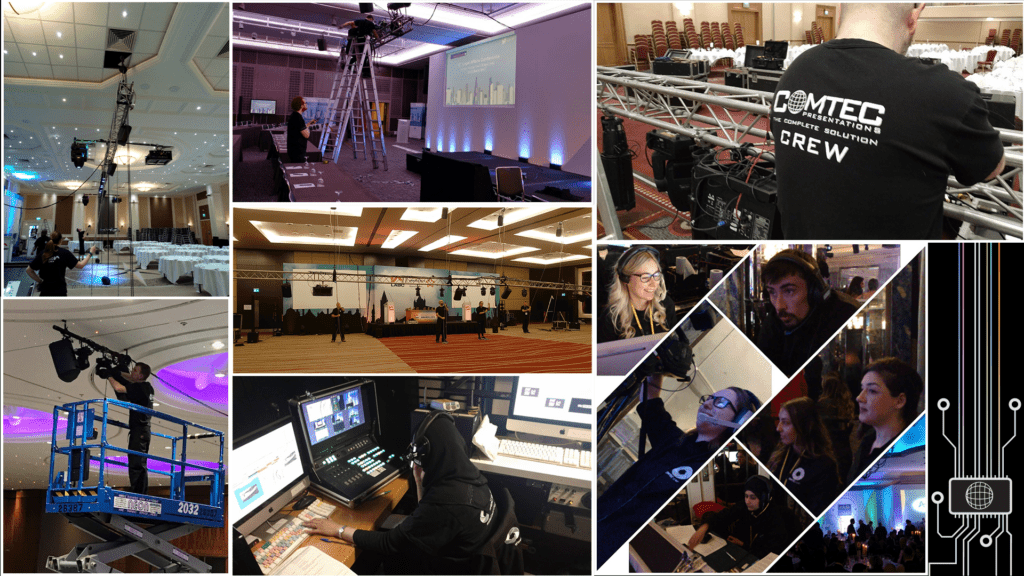
Bringing an experienced production team into the project before the venue, stage and technical decisions are fixed gives everybody more options.
We can help assess venues, develop production ideas, identify potential problems, advise on budgets and work with your internal team to turn the initial objective into something that works in the real world.
Sometimes that means recommending more production.
Sometimes experience tells us you don’t need it.
Both can save money.
When Should You Involve an Event Production Company?
Ideally, earlier than most people think.
Bringing an experienced production team into the project before the venue, stage and technical decisions are fixed gives everybody more options.
We can help assess venues, develop production ideas, identify potential problems, advise on budgets and work with your internal team to turn the initial objective into something that works in the real world.
Sometimes that means recommending more production.
Sometimes experience tells us you don’t need it.
Both can save money.
Planning an Employee Event?
Comtec has spent more than four decades producing live events for organisations across the corporate, public and membership sectors.
From employee conferences and awards ceremonies to launches, hybrid events and complex live productions, we combine creative thinking, technical production and experienced people from the initial idea through to show day.
You don’t need to arrive with an equipment list.
Tell us what you’re trying to achieve. We’ll help work out how to make it happen.